Upland Game Identification
 Identification Tips:
Length: 10 inches
Weight: males 14.0 oz; females 13.5 oz.
Flight speed: 30-40 mph.
Habitat: open landscapes of intense small grain and row crop agriculture.
Foods: waste grains and weed seeds.
Life expectancy: 70-90% annual mortality rate; few birds live to age 3.
Mating: monogamous; remain paired throughout the breeding season.
Nesting period: peak April-June; range April-August.
Nests: usually shallow, scratched-out depression in the ground lined with grass or leaves.
Clutch size: Ave. 16 eggs (range 10-20); first nests larger.
Eggs: olive-buff; ovate (1 1/2" x 1 1/8").
Incubation: 23 days.
Young: precoccial; leave nest immediately and can make short flights at 12-14 days.
Number broods per year: 1; persistent re-nester.
Fledge: young resemble adults at 16 weeks and remain with adults in coveys through fall and winter.
Migration: none, year-round resident.
Sexes similar
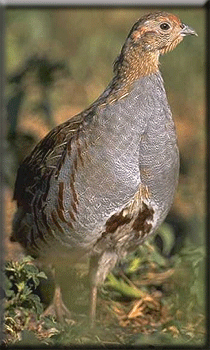
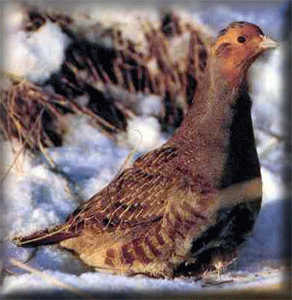
Stocky, ground-dwelling partridge with short, rounded wings
Grayish-brown bird without bright markings
Short, thick, pale bill
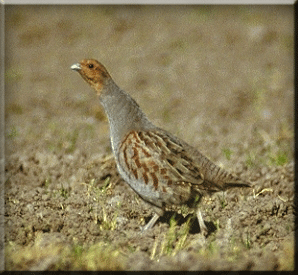
Tawny cinnamon face with uncrested brown crown and ear patch
Gray nape and breast with fine, dark vermiculations
Brown back and upperwings
Reddish-brown bars on flanks
Rufous outer tail feathers visible in flight
Male has dark brown patch on center of belly, female has smaller or absent marking
Immatures similar to adults but have yellow rather than blue-gray feet
Similar species:
Chukar has red bill, black eyeline and necklace, and black bars on flanks. Northern Bobwhite has different face pattern and is smaller with a grayish tail in flight.
During hunting season, partridge are usually found in coveys. The coveys often flush en masse, presenting a hunter with a variety of targets. Concentrating on one bird, rather than giving in to the temptation of a flock shot, will lead to more partridge in the bag. Once you have a bird in hand, you can tell whether the bird is a male or female by looking at the shoulder area of the wing. Males generally have more rust colored wings than females. Female wings are more brown, and exhibit dark brown cross bars and brown mottling on the shoulder patch. The photos below shows partridge wings with the distinct markings revealing identification of sex.
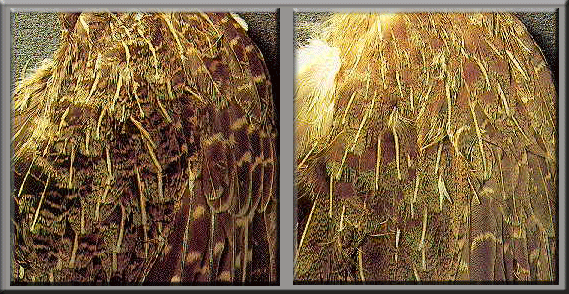
| Left: The feather pattern on the shoulder of a Hungarian partridge wing will tell you whether the bird is a male or female. A mottled coloration overall, and brown crossbars on individual feathers, indicated this wing came from a female Hun.
Right: The soulder feathers on a male Hungarian partridge are somewhat rust-colored. Dark rust crossbars mark some of the feathers, and males do not have the dark brown stripes or mottling found on females. Of the two photos used to demonstrate partridge age in this section, one is from a male, and one from a female. Using the information above, see if you can tell which is which before you read the captions. |
You can tell whether a partridge is a young-of-the-year or adult by checking the molt and/or appearance of the outer primary wing feathers. Early in the season, if the number nine or 10 primaries are still growing, the bird is an adult. If primaries eight or seven are growing, then the bird is a juvenile.
Later in the season, when most birds have fully grown wing feathers, you have to look at the wear on the ninth and 10th primaries. As with many other upland game species, if the outer primaries are rounded and smooth, the bird is a adult. If the primaries are more pointed and the ends are frayed, the bird is a juvenile.
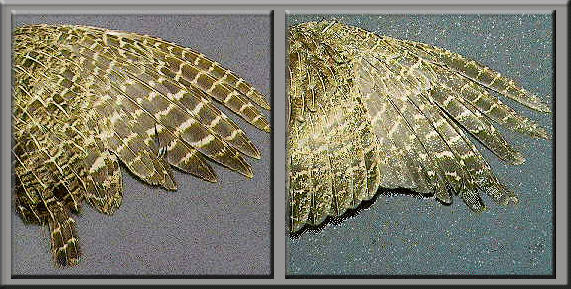
| Left: This wing is from an adult female Hun. Note the relatively smooth tips of the outer two primary wing feathers.
Right: This wing is from a young-of-the-year male Hun. Note the frayed edges of the outer two (ninth and 10th) primary wing feathers. |
Food Habits
Insects and other invertebrates supply badly needed protein for rapidly growing chicks. Weed seeds, waste grain and green; leafy material becomes important in the diet of older birds. During the summer months, partridge broods often feed in the cover provided by soybean fields switching to cornfields in early fall. In winter, partridge will scratch and burrow under snow in search of waste grain and green vegetation. Some studies indicate partridge eat much more green matter than pheasants.
 Limiting Factors
As with pheasants, lack of suitable, undisturbed nesting habitat is thought to be an important limiting factor for gray partridge. Mowing and burning of road ditches during the nesting season and removal of old farmsteads and fencerows greatly reduces the amount of available nesting habitat. Other research shows gray partridge reproduce best during droughty-warm springs.
Unlike pheasants, lack of winter habitat does not seem to be a serious limiting factor for gray partridge. Even during bitter cold weather partridge can be observed feeding in open, wind-swept soybean fields or fall-plowed cornfields. Rugged winter weather conditions in the northern regions of its native Eurasia seems to have better prepared the gray partridge for winter survival when compared to the ring-necked pheasant, native to the milder regions of central Asia. The partridge's ability to snow roost also gives it a distinct advantage over pheasant and bobwhite quail, which do not exhibit this behavior. Deep-crusted snow during some winters can prevent partridge from finding enough food. Under these conditions, partridge may adapt by feeding around corncribs or feed lots.
 Broods raised along heavily traveled roads can suffer substantial road kill losses. Hawks and owls take some partridge during the winter, and skunks and other mammals catch incubating hens and destroy nests. Hunting mortality is usually very low due to the wary nature of the birds.
Habitat Needs
Gray partridge seem to survive and even increase in numbers in intensively farmed regions unsuitable for other upland gamebirds. Gray partridge thrive in areas with abundant small grains, especially wheat, interspersed with light or moderately grazed pastures, idle areas, and row crops. Partridge attain their highest densities in regions where these habitat types are evenly interspersed (uniformly distributed). Given their origin in the arid agrarian grasslands of Eurasia, it is not surprising the gray partridge finds open agricultural landscape to its liking.