Upland Game Identification
Gray Squirrel
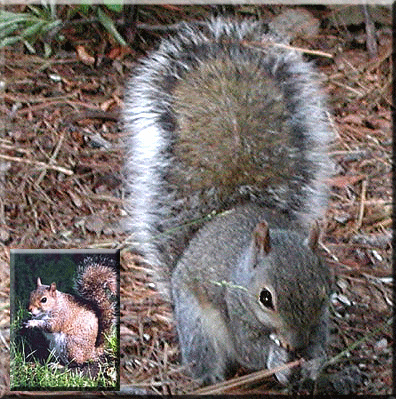 Eastern gray squirrels are found throughout the eastern United States; their natural range extends from Florida, north to Canada, and west to where the deciduous forests meet the great plains grasslands. There are 5 subspecies of eastern grey squirrels, S. carolinensis carolinensis is the subspecies found in most of the south from northern Florida, to North Carolina, west to Missouri, and eastern Texas.
General Characteristics
Gray squirrels are medium sized arboreal, or tree squirrels. Their back is grizzled dark to pale gray and may be tinted with reddish coloration on their hips, feet and head. The tail is white to pale gray and as is their stomach. In the north, both their ears and soles of the feet grow heavy fur during winter. Generally, there is no difference between males and females with respect to size or coloration. They are distinguishable from their close cousin, the fox squirrel (S. niger), in that fox squirrels are at least 20% larger and have guard hairs tipped with tawny, brown, or orange instead of white as in grey squirrels.
In natural conditions, grey squirrels live to 7 or 8 years of age, although one individual lived to 20 years of age in captivity. They tend to be larger in the northern part of their range than in the southern part of their range. Their bodies measure 380 - 525 mm total length, 150 - 250 mm tail length, 25 - 33 mm ear length, 54 - 76 mm right hind foot length, and they range in weight from 300 - 710 grams. Eastern gray squirrels have both a summer and winter coat, and therefore molt twice each year. The spring molt begins in March, whereas the autumn molt begins in September, but the tail only molts once each year in July.
Gray squirrels have four sets of whiskers located above and below the eyes, on the underside of the head in front of the throat, and on the nose. Whiskers, also known as vibrissae are touch receptors that provide the animal with information about its immediate surroundings. Gray squirrels have very good eyesight even in dim light, and a wide field of vision. They also have a well-developed sense of smell and hearing.
Squirrels have upper and lower incisor teeth followed by a gap called a diastema. The diastema is where the canine teeth would normally be found in carnivorous animals such as cats or dogs, or omnivorous animals such as monkeys. Behind the diastema are the cheeks or grinding teeth, which consist of premolars and molars. As with other rodent species, the incisors continuously grow to compensate for the enormous amount of wear that comes from a herbivorous diet. Young squirrels have milk teeth, which are replaced by permanent teeth when they are between six and twelve months old.
Gray squirrels are highly adapted for climbing trees and fatal falls are rare. Adaptations for climbing trees include tough curved claws, and the ability to reverse their hind foot 180 degrees to permit headfirst descent. Gray squirrels are excellent climbers and can leap considerable distances using powerful hind limbs. Tails are used for balance when running and leaping between trees, and held over the back of a resting animal.
Reproduction
Eastern gray squirrels have two breeding seasons per year, and most breeding occurs in December - February and May - June of each year. Females can have two litters per year, one from each breeding season. Average litter sizes range from 2 - 3 individuals; the winter litter is generally smaller than the summer litter. Both sexes remain reproductively active throughout their lives. Female eastern gray squirrels have been known to produce litters as young as 5 ½ months of age in the southern part of their range, but most do not reproduce until 1.25 years of age. An enlarged pink vulva is usually visible the day before the onset of estrus.
Male gray squirrels are sexually mature at 10 - 11 months of age. Functional testes descend in the scrotum from December to February and May to July, although testes may stay descended without spermatogenesis until October. Five - ten males begin to follow females up to 5 days before estrus, although as many as 34 males have been documented to follow a single female. A dominance hierarchy is formed among the males, and on the day of estrus females will mate first with the dominant male. However, she will also mate with several other males throughout the day.
Juvenile squirrels are born without hair and weigh between 13 and 18 grams. Hair begins to grow on the tail and dorsum by 21 days, and on their ventrum by 42 days. Eyes open at 24 - 42 days, ears at 21 - 28 days, lower incisors erupt at 19 - 21 days, upper incisors in week 4 and cheek teeth in week 6. Weaning begins at 7 weeks and is complete by 10 weeks. Adult body mass is reached after 8 - 9 months.
Juvenile males are more likely to leave the natal area and disperse than are juvenile females. Dispersal usually occurs during the fall and young males move between 1 and 16 kilometers away from their natal nest. The longest recorded dispersal is 100 km. Dispersal is a high cause of mortality among males, which results in adult sex ratios of 0.85 males: 1.6 females.
Habits
Gary squirrels are active year round during the daytime. Even during the most severe winter weather they will leave their nests for short periods of time to forage for food. Activity is bimodal from late spring to autumn with peaks 2 hours after sunrise and again 2 - 5 hours before sunset.
Gray squirrels are non-territorial. They have large overlapping home ranges, which average 5 hectares in size, but can vary from 0.5 hectares to greater than 20 hectares. Males have slightly larger ranges than females, due to an increase in their range during the breeding season. Home range sizes also increase during spring and summer for both sexes and are negatively correlated with food supply and squirrel population density.
Gary squirrels are most commonly found in mature continuous woodlands greater than 40 hectares in size. Densities are highest in habitats composed of tree species that produce foods suitable for storing over winter such as oak, hickory and walnut. Due to variability in seed production in different years, a diversity of nut trees is important to support high densities.
Gray squirrels are generalist feeders. Eighteen plant species account for 87% of their diet, but they may feed on as many as 97 plant and 14 animal items. Squirrels feed heavily on nuts, flowers, and buds of 24 oak species, and 10 species of walnut, hickory and pecan. Other food items include the fruits, seeds, buds or flowers of maples, mulberry, hackberry, elms, buckeyes, horse chestnuts, wild cherries, dogwoods, hawthorn, hazelnut and ginkgo. Pine tree seeds and pollen cones are readily eaten including cedar, hemlock, pines, and spruce. Fungi are also consumed when readily available in summer, as are cultivated crops in winter. Animal food items include bones, bird eggs, nestlings, and frogs.
Food consumption peaks in summer or autumn and decreases in winter. Autumn rates of food consumption exceed energetic needs by 32% so that the animals can increase their weight before the onset of winter. Eastern grey squirrels are classic scatter hoarders. They carry nuts in their jaws and bury them in various locations within their home ranges. Olfaction and memory are used in locating their caches.