Upland Game Identification
Fox Squirrel
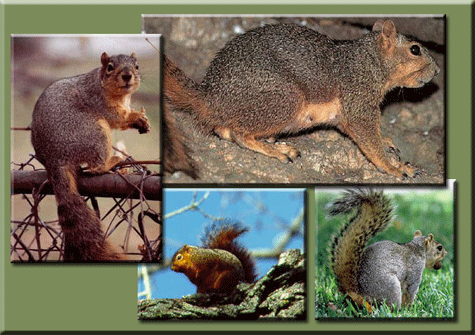 Fox squirrels are the largest arboreal, or tree squirrels. There are three different color phases; in the northeastern part of their range they have grey backs with yellowish bellies, in the western part of their range they are reddish in color, and in the south they are often black with a white blaze on their face and a white tipped tail. In addition several members of the species in South Carolina have white ears. Generally, there is no difference between males and females with respect to size or coloration.
Their bodies measure 450 - 700 mm total length, 200 - 330 mm tail length, 51 - 82 mm right hind foot length, and they range in weight from 500 - 1000 grams. Fox squirrels have both a summer and winter coat, and therefore molt twice each year. The spring molt begins in March, whereas the autumn molt begins in September, but the tail only molts once each year during the summer.
Fox squirrels have very good eyesight even in dim light, and a wide field of vision. They also have a well-developed sense of smell and hearing.
Habits
Fox squirrels are active year round during the daytime. Even during the most severe winter weather they will leave their nests for short periods of time to forage for food. Activity is bimodal from late spring to autumn with peaks 2 hours after sunrise and again 2 - 5 hours before sunset.
Fox squirrels have large overlapping home ranges and are non-territorial. Fox squirrels are most commonly found in oak-hickory forests. In the south they will also be found in live oak and mixed forests, cypress and mangrove swamps, and in piney areas.
Fox squirrels are generalist feeders and their diet is dependent upon the area in which they are found. Squirrels feed heavily on nuts, flowers, and buds of 24 oak species, and 10 species of walnut, hickory and pecan. Other food items include the fruits, seeds, buds or flowers of maples, mulberry, hackberry, elms, buckeyes, horse chestnuts, wild cherries, dogwoods, hawthorne, hazelnut and ginkgo. Pine tree seeds and pollen cones are readily eaten including cedar, hemlock, pines, and spruce. Fungi are also consumed when readily available in summer, as are cultivated crops in winter. Animal food items include bones, bird eggs, nestlings, and frogs.