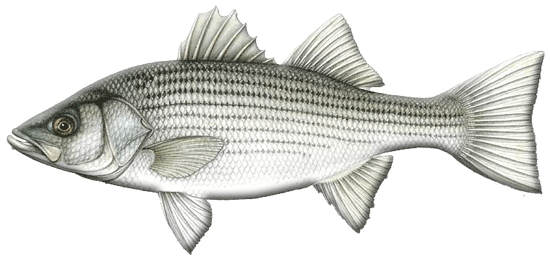
Fresh Water Fish Identification
COMMON NAME: STRIPED-BASS
OTHER NAMES: STRIPER
SCIENTIFIC NAME: Morone saxatilis
RANGE AND HABITAT: Native to the Atlantic Ocean, and its coastal tributaries. Striped bass prefer large bodies of deep, cool water.
FOOD: Primarily small fish
ADULT SIZE: Normally 12-24 inches and weigh 1-5 pounds. Grows much larger in saltwater habitats.
IDENTIFICATION: Long, silvery fish with 7-9 distinct lines running lengthwise along sides and back. Sharp spine on gill cover. Teeth on the base of the tongue are arranged in 2 parallel patches.
The striped bass is the largest member of the sea bass family, often called "temperate" or "true" bass to distinguish it from species such as largemouth, smallmouth, and spotted bass which are actually members of the sunfish family Centrarchidae. Although Morone is of unknown derivation, saxatilis is Latin meaning "dwelling among rocks." As with other true basses, the dorsal fin is clearly separated into spiny and soft-rayed portions. Striped bass are silvery, shading to olive-green on the back and white on the belly, with seven or eight uninterrupted horizontal stripes on each side of the body. Younger fish may resemble white bass (Morone chrysops). However, striped bass have two distinct tooth patches on the back of the tongue, whereas white bass have one tooth patch. Striped bass have two sharp points on each gill cover, and white bass have one. Additionally, the second spine on the anal fin is about half the length of the third spine in striped bass, and about two-thirds the length of the third spine in white bass.
FISHING TIPS: Live gizzard shad are the most productive live bait. Jigs, jigging spoons, and crankbaits are good lures for casting. Trolling with large, deep-diving crankbaits can also be effective.