Waterfowl Identification
Blue-Winged Teal
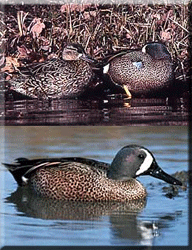 Identification Tips:
Length: 11 inches Wingspan: 24 inches
Small dabbling duck
Medium-sized bill without spatulate tip
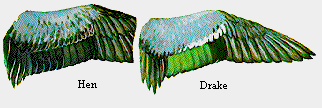
Pale blue upper secondary coverts
Green speculum with white leading edge
Dark bill
Juvenile similar to adult female
Adult male alternate:
Alternate plumage worn from early winter through early summer
Blue-gray head with darker cap
White crescent on face in front of eye
Buff breast and flanks with darker spotting
White band at rear portion of flanks
Black undertail coverts
Adult male basic
Similar to adult female, but forewing brighter
Adult female:
Pale head
Dark crown and eye line
Pale eye ring, and loral spot
Mottled gray-brown body plumage with darker back
Similar species:
Adult in alternate plumage is unmistakable. Female, immature and eclipse male similar to Green-winged and Cinnamon Teals. Note the small size and small bill of the Green-winged Teals as well as the green speculum. Cinnamon Teal is very difficult to distinguish in some (female) plumages, but note the smaller bill without a spatulate tip and the more distinct facial pattern (pale loral spot and more distinct eye line) of the Blue-winged Teal.
Migrating and Wintering: Blue-winged teal are generally the first ducks south in the fall and the last north in the spring. They migrate from the prairie pothole region to wintering areas in Florida, the Caribbean Islands, the Gulf Coast of Texas and Louisiana, Mexico, and Central and South America. Wintering habitats are diverse, including mangrove swamps, fresh and brackish estuaries, and shallow wetlands. In the USA, the highest winter densities occur in southern Texas and peninsular Florida. Blue-winged teal are common in winter from Central America, the Caribbean and South America south to Peru and northeastern Brazil. They also stay regularly in small numbers in the Galapagos Islands, and are vagrants to Chile, southeastern Brazil, Uruguay and Argentina.
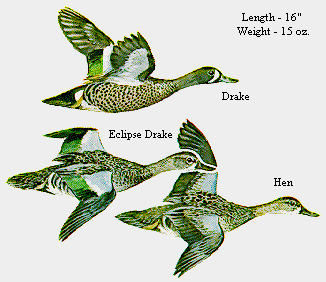
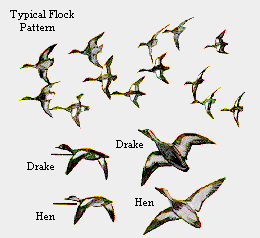
Their small size and twisting turning flight gives the illusion of great speed. The small, compact flocks commonly fly low over the marshes, and often take the hunter by suprise. They are more vocal than most ducks - their high-pitched peeping and nasal quacking is commonly heard in spring and to a lesser extent in fall.
These teal are among the first ducks to migrate each fall, and one of the last in the spring.