Steelhead Basics
Article Submitted By: Kevin Pittman

I’ve only been steelhead fishing for about four years now and my knowledge outside of my own experience and readings come from two men: Greg Katello of Fishing Connection in Tinley Park, IL and Glen Gage. After I hooked into my first steelhead from an Indiana creek no wider than most people’s living room, it has become an obsession, and through this obsession I have come to see this style of fishing as an art form. What do I mean when I say art form? I mean long noodle rods, light lines, stealth, tiny differences in presentations, solitude and logjams. You will see people out there with heavy rods and 20 pound test and they may catch fish, but pure steelhead fishing is a state of mind. If you have ever heard Ken Gortowski (www.waterdogink.com) speak of the Fox River, it is kind of like that, almost a love affair.
When I first ventured forth, and Greg Katello set me up with a 9-½ foot medium light St. Croix, I thought he was crazy, 9-½ foot for what? Well…..Now that same rod is my shortest. Setting up with a rod/reel combo is part necessity and part preference. Long rods are preferred for a few reasons. First, negotiating your environment, if you ever get out to the creeks you will understand, high banks, standing structure, shoreline ice and downed trees to name a few. Long rods give you an advantage by allowing you to put your lure where you want it to be. When fighting a fish, it allows you to negotiate the structure through many runs and aerobatics and gives your lighter line a few more pounds of strength due to all the play. I currently use a 9-1/2 foot ML for lure presentations and a 10-1/2 and 13 foot light rod for live bait presentations. I also recommend a rod with a good warranty. The first year out, I broke a rod tip on a tree trunk while setting a hook. This is not to say you cannot go into the creeks with a 6 or 7 foot rod and catch fish, but you will wish many a time, that you had another foot or two.
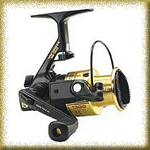 When choosing reels for steelheading, there are a few options and most choices are based on preference. 99% of the time you will be using a spinning set up, and in the creeks you will want a reel that will hold 100-150 yards of line with a good drag system. Oh, and one you will not get upset about when you drop it into the mud or beat it up an a rock. My preference is the 1600 Daiwa Tournament ss series, you cannot beat the drag system and adjustments require minimal movement of the cap. Other options are of course a bait caster, which has minimal applications in a forage-covered area, and a centerpin reel, which is more widely used on the West Coast and in Europe. To get a sense of a centerpin reel, imagine an oversized fly reel that is free spinning with no drag system. It has a tension setting, which you match to the current that allows you to float a presentation downstream, taking line freely as it goes, without slack in your line. No drag you ask? Well you actually do have one, the palm of your hand. Centerpin reels are very limited in production and availability and therefore can be quite pricey starting around the $300-400 mark. I currently picked up an inexpensive one on e-bay, and have yet a chance to play with it on the water.
Other gear you will want to consider, other than lures, will be waders, (for um… wading), and light tackle boxes, and other gear. I use a fly fishing vest with small tackle boxes that fit into the pockets. You would not believe how much gear you can fit into one of those vests. You will be doing a lot of walking and exploring, so you do not want to be weighed down. You will also need a long handled net, as long as possible. There are several models, which have an extending handle up to 72 inches, and you will require every inch trying to reach a fish over rocks or down a high embankment. Some may argue this one, but I always wear and recommend camouflage or at least dark clothing, jackets etc. You will be in shallow, clear water and nine times out of ten you will spook fish just walking into the area. I lost count of how many times I noticed fish only to figure out they saw me way before I knew they were there.
There are many different lure presentations you can use. Crank baits, jigs, spinners, spoons and so on. But your basic in-line spinner is a tried and true presentation. Before we go any further, Indiana regulations state that you cannot have a single hook with a gap no larger that a ½ inch and a treble hook with a gap no larger than 3/8 of an inch, while in the tributaries of Lake Michigan. With that said, #2 and #3 mepps style spinners are the gold standard. I generally use plain #2 spinners in gold, silver and copper. You can use spinners with color, and when considering steelhead it is orange, orange, orange, but I have found that color works better on the Big Pond and less in the creeks. You can also use spinners with tails and trailers, but again I have found a plain spinner works fine. You will want to work your spinners trying various methods until you find what the fish want.
Generally as a rule, I prefer to cast upstream and work a medium fast retrieve to keep it moving and not sinking any further, and work the water column. I will start shallow and work toward the bottom, depending on the depth. The majority of steelhead I have caught while using a spinner was while the bait was running deeper and with the current. They also are suckers for a stop and retrieve presentation, if you can get a spinner that will spin on the fall it is deadly. Steelhead will tend to stay in cover or around a structure unless they are on the move. You will want to get that spinner towards the bottom of structure, which we’ll discuss later. A spinner also can be worked around a logjam or rapid by letting it work with the current, or slipping it into or under logs and jams. This also produces many fish, but then the trick is getting them out of there. The key, as is with most fish, is to experiment and see what the fish want, varying your retrieves and actions between speeds with a stop and go or constant jigging/twitching the lure. When using a lure presentation, you will want to run 8-10 LB test, and something that will take some abuse. I generally will use McCoy’s co-polymer and find it will take the abuse and responds well when fighting and controlling a fish. In the winter months though I will switch to 10-LB fireline, which respond well in colder water and cuts through ice on your guides with no problems.
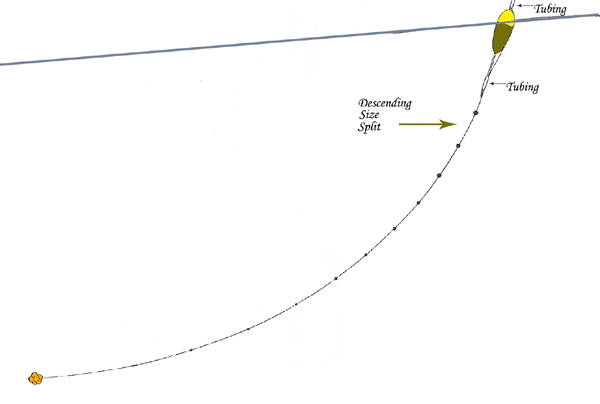
 When someone ever mentions steelhead fishing though, my mind goes to float set-ups. The heart of steelhead fishing is in float fishing techniques, and there are many different options. Your basic set up is a light float above a split shot and a size #6 or similar size hook, just barely dragging the bottom with spawn, skein, shrimp or wax worms. My current preference is a set up using clear plastic floats made by Redwing tackle or Drennon, attached with surgical tubing so that you can adjust the depth of your bait. You then use 3-5 split shot of various sizes; descending in size the closer you get to the hook. And finally a #6 octopus style hook or something similar. I generally will use an octopus style for spawn and a #10 mustad all around for wax worms. You can also experiment with color; steelhead respond to color and red hooks can make a difference.
When working your float set up, it is fairly self-explanatory. But I would highlight trying to fish around structure, eddy’s, slack water and deeper holes, where they may be staging. You can work the float two ways, but usually on a drift you will use a combination of the two. Remember that deeper running water will usually move slower than the upper column. So the float will be directing the bait when up stream from you, but once there is tension on the float and downstream, your presentation will swing out in front. The main thing to remember is to keep your presentation just bouncing off of on just above the bottom, this may not always hold true, but in a natural presentation that is where your bait would lay or move. This is where being able to slip the float using the tubing set up is beneficial. Also don’t always expect a steelhead to slam your bait, they may sniff it or just slightly draw it into their mouth. Look for irregularities in your float's movement. Sometimes the float will just stop in its place or even move perpendicular to shore or upstream slowly. Set that hook. If you see your float stop for a second and then move on, especially in an area where it hasn’t on a previous drift, most likely a fish picked it up and dropped it. Drift that again, I have caught many a steelhead on a second or third drift after the already hit it.
Baiting your hooks is straightforward. All I would add to this though is to experiment with size and color presentations. Some days will call for 5-6 wax worms on a hook and another will call for 1-2 on a hook or even a small jig. Also with spawn, experiment with color of the netting, size and adding a float in the sac. Last year I did well with pink netting, this past year was straight orange. You cannot be afraid to experiment, especially if you’re not getting into the fish. Steelheads respond strongly to color and scent, so mix it up.
Kevin is an avid fisherman and hunter, staff member of Chitown-Angler, and frequent contributor to the forums.